Outdoor Break Areas and Employee Wellbeing: What Employers Can Change

In this article
Watch where people go when they take a break and you learn a lot about a workplace. In some offices and shops, everyone stays at their desk with a sandwich and a screen. In others, a handful of people stand by the loading door or sit on the curb by the parking lot, because that's the only outdoor spot there is. If you're researching concrete Franklin TN businesses use for patios and outdoor areas, you've probably already noticed that the break people actually take depends on having somewhere decent to take it.
This article is about assessing that space, or the lack of it. It covers what to look at, what an outdoor break area can and can't tell you about your team, the options for building or improving one, and, the part I care about most, how you'd know whether it made any difference.
Pulse check
- Do most of your people eat lunch at their desks or workstations?
- Is there anywhere outside your building where someone could sit for ten minutes without standing in a parking lot?
- If you asked your team where they go to clear their heads, would you already know the answer?
What to look at
Start by mapping what exists, not what you think exists. I've seen many organizations list an "outdoor seating area" in their benefits materials that turns out to be a single bench by the dumpsters. So go and look, at the times people actually take breaks.
Things worth checking:
- Where people go now. Note the spots people use for breaks, phone calls and fresh air, including the informal ones: steps, curbs, the edge of the loading bay, their own cars.
- The surface. Gravel, mud, cracked paving, or a sloped patch of grass all discourage use. Uneven ground also matters for anyone with limited mobility.
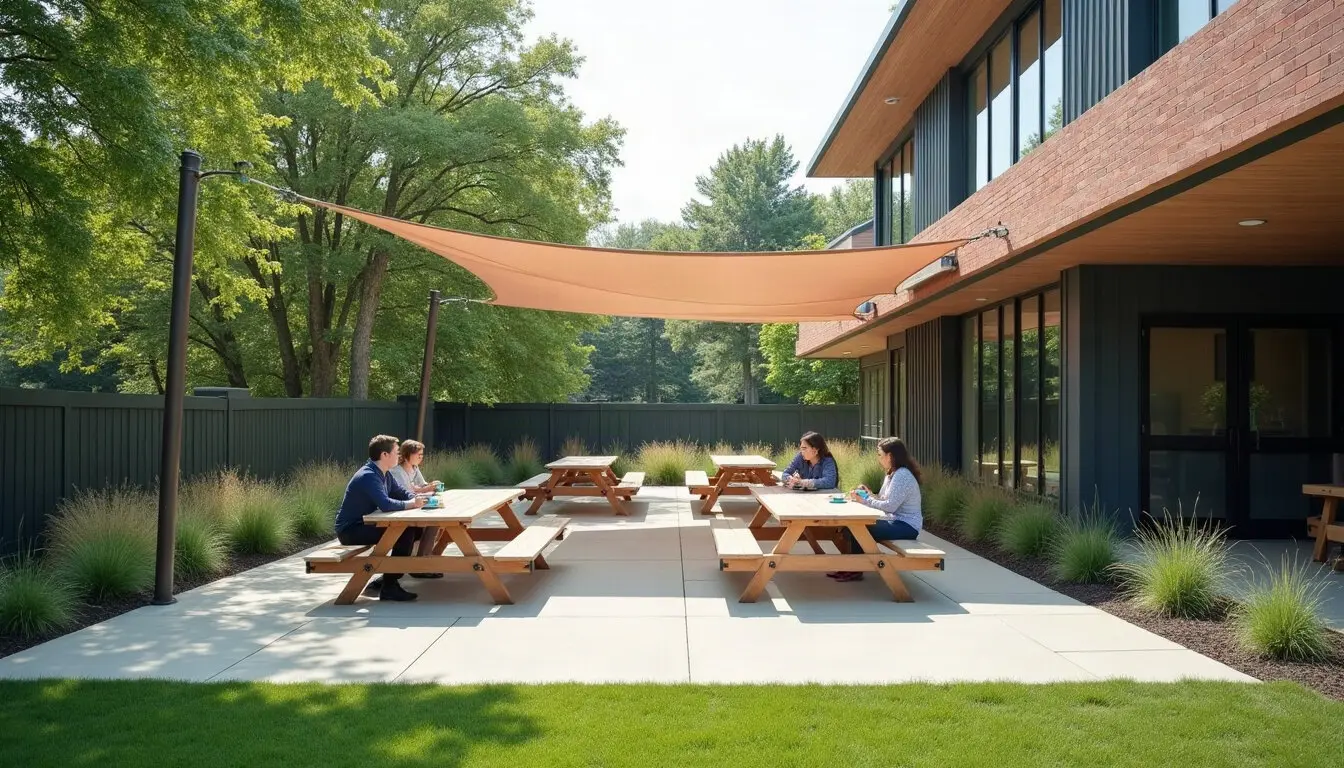
- Shade and shelter. In a climate with hot, humid summers like middle Tennessee's, an outdoor area without shade sits empty for months.
- Seating. Is there enough for a few people at once, and is it something people would choose to sit on?
- Distance and privacy. A space next to a busy entrance doesn't feel like a break. A space a long walk away won't get used in a short one.
- Who it's for. Check whether shift staff, field crews and office staff all have access, or only the people near one door.
Turn what you see into plain observations: "four people eat in their cars most days" is far more useful than "the team seems to want outdoor space."
What it tells you
Here I'd separate what's well supported from what's merely popular.
It's widely accepted that breaks matter. Stepping away from a task, changing your surroundings and moving a little helps people come back to work with better attention. Public health bodies have long encouraged employers to make it easy for staff to take regular breaks, be physically active during the day and get outside. Time outdoors and green views are also commonly associated with lower stress, and most people will tell you they feel better after a few minutes of fresh air.
What's less certain is how much any single feature, like a new patio, changes how people feel. The honest answer is that it depends on whether people use it, and whether the rest of the working day lets them. A beautiful outdoor area won't help a team whose schedule doesn't allow a lunch break. So treat the space as one condition among several, and avoid promising your team that it will "improve wellbeing." Promise them somewhere better to sit.
What your observations tell you is mostly about permission and practicality. If people eat at their desks because there's nowhere else, that's a facilities problem with a clear fix. If they eat at their desks because nobody else takes a break, that's a culture problem, and a patio alone won't solve it.
What to change
Options range from cheap and quick to a proper building project. The table sets them side by side.
| Option | What it changes | Who does it | Effort |
|---|---|---|---|
| Move existing seating to a quieter, shaded spot | Makes a current space usable without new work | Facilities or the team | Low |
| Add portable shade and outdoor tables | Gives a sheltered place to eat and talk | Facilities | Low to moderate |
| Repair cracked or uneven paving | Safer footing, easier access for everyone | Concrete contractor | Moderate |
| Build a concrete patio with permanent seating | A dedicated, level break area that lasts | Concrete contractor, with landlord if leased | Significant |
| Add a short walking path around the site | Encourages movement during short breaks | Contractor, landscaper | Significant |
Start with what you have
Before anything is poured, try the cheap version. Move a couple of tables to the shadiest corner of your lot and see whether people use them. This is a small test with a clear question: if there were somewhere to sit, would people go there?
Give the test long enough to mean something. A single sunny week tells you very little; three or four weeks across different kinds of weather tells you much more. Keep a simple note of what you see each time you walk past, and resist the urge to read meaning into one busy or empty day. The aim is a before-and-after you can actually point to when someone asks whether a bigger project is worth it.
When to bring in a contractor
If the test shows demand, a permanent surface is often the next step. Laying a patio, repairing a cracked slab or fixing a sunken path is work for an experienced concrete contractor. A good one will look at drainage, the ground underneath and how the area connects to doors and paths, and will explain what they recommend and why. If you lease, involve your landlord early; outdoor works usually need their agreement, and permits are a question for the local building department.
Plan the works around the team
Construction next to a workplace is noisy and disruptive. Tell people when the work is happening, which entrances or parking spaces will be affected, and roughly how long it will take. A short, clear notice prevents a lot of grumbling.
Fix the permission problem too
Change one habit at the same time as the space. If managers eat at their desks, their teams will too. Ask leads to take their own breaks outside, visibly, for the first few weeks.
How to tell it worked
This is where most workplace improvements fall down: nobody decides in advance what success looks like, so nobody can say whether it happened. Before the new area opens, write down two or three things you expect to change, then check them.
Useful observations, none of which need a survey:
- Who uses the space, and when. Walk past at lunch a few times a week for the first month. Is anyone there? Is it the same three people, or a mix?
- Where people eat. Compare with your original map. Fewer people in cars and at desks is a good sign.
- What people say unprompted. Comments in team meetings or one-to-ones about getting outside are worth noting.
- Seasonal use. Check again when the weather changes. A space that empties in summer may need more shade; one that empties in winter may just be seasonal, which is fine.
If you run a regular engagement or pulse survey, you can add a simple question such as "I'm able to take a proper break during my working day." Track it over time rather than reading too much into one result. Treat it as a signal, not a verdict.
And if the space isn't used, ask why before you conclude people don't want it. It may be too far, too exposed, or too close to the manager's window.
The first change to make
This week, walk your site at lunchtime and write down exactly where people take their breaks, including the cars and curbs. That simple map tells you whether you need a new space, a better one, or a change in habits, and it gives you a baseline to measure against once you've made a choice.
A good break area won't change a demanding job, but it gives people a better place to step away from it.